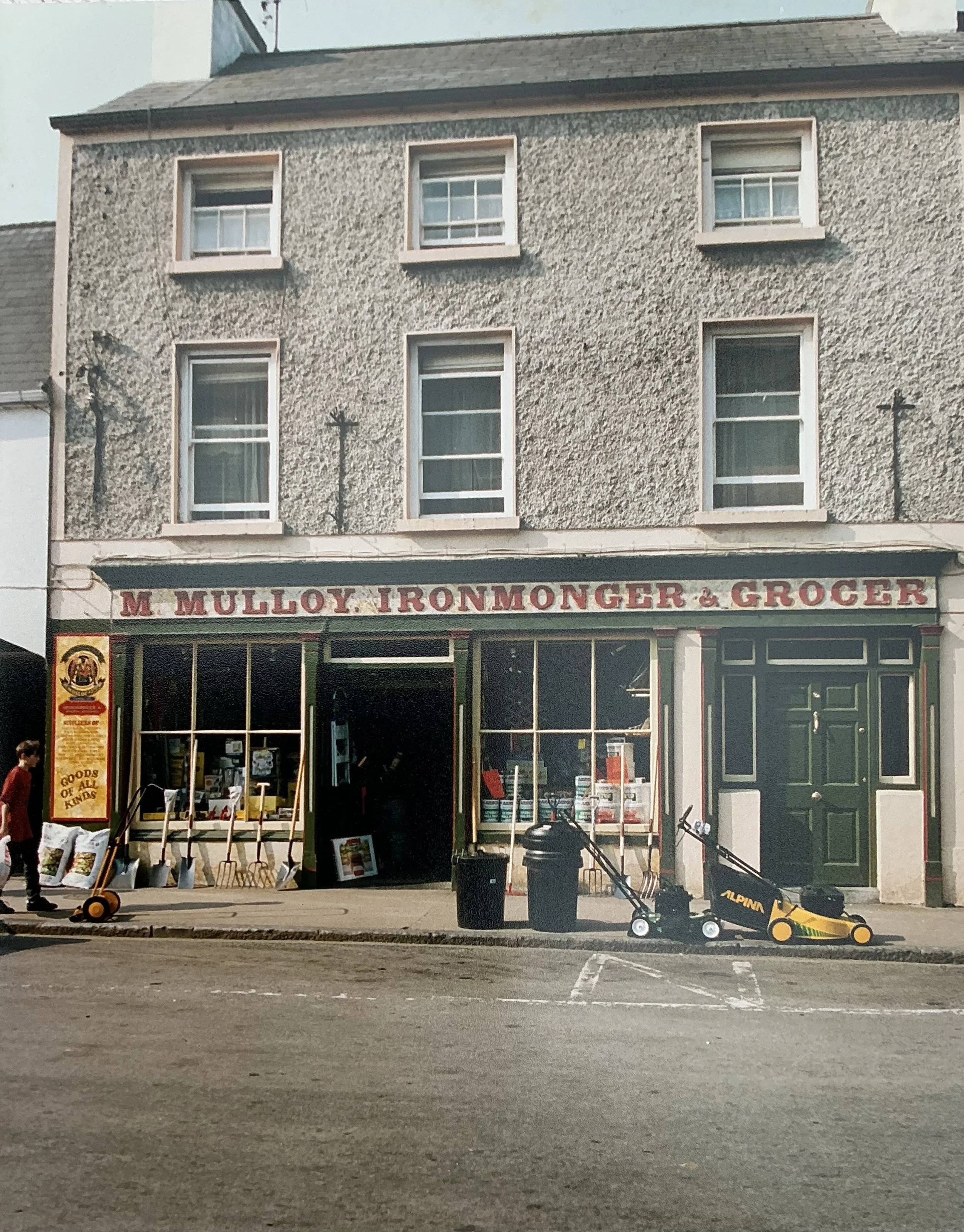
M. Mulloy & Sons, Merchants of Westport
On Tuesday 21st April at 8pm in the Walnut Suite in the Westport Plaza Hotel, Westport Civic Trust will present John Mulloy talking about the history of the Mulloys, merchants of Westport from 1762 until 1995. For six generations, they occupied No. 8 Shop Street, through the upheavals of rebellion, famine, war, and economic depressions. The commercial trajectory of this family business shows how capitalism in Ireland grew through the gradual transformation of tenure, trade, and maritime connectivity.
Beginning in the late 18th century, the family operated in the context of what is sometimes called ‘war capitalism’. This was the period of imperial expansion and armed trade, a merging of public and private power, when economic growth could take place without technological change or gains in productivity. The Brownes of Westport House are a classic example of this, relying on enslaved labour in Jamaica and an impoverished peasantry in Mayo. They tried to integrate the two by producing low-quality linen locally to clothe enslaved labourers in the Caribbean. Exercising almost absolute power in Mayo until the establishment of the Royal Irish Constabulary in 1822, shopkeepers were suspected by the Brownes of being ‘illuminated’ by radical ideas through commercial contacts in Dublin and further afield. However, the Mulloys managed to establish themselves as part of the new solid Catholic middle class in Mayo.
By the mid-nineteenth century, when Westport’s economy was reshaped by famine, emigration and global timber imports, families such as the Mulloys had accumulated modest but durable forms of capital rooted in place. With the death of John Mulloy in 1851, his widow Mary was left at the age of 34 with six young children and a business to run at the tail end of the Famine. Despite this, she successfully seized the opportunities available in the new phase of industrial capital. Mulloys’ coal and timber yard, supplied through Baltic trade networks and embedded in local building markets, shows how the local middle class adapted to global capitalism. Developing a business based on the latest technology, expanding from simply importing timber to processing it and finally setting up a joinery works, Mulloys created a network of elite clients among the landed gentry and successfully tendered for the Workhouse, the railways and various relief projects. This meant that the family had to navigate the difficult terrain of squaring their own active involvement in nationalist politics with engaging commercially in the British colonial project, as well as dealing with increasing class tensions locally.
Following independence, the difficulties of using Westport Quay as a base for imports began to show. During the Economic War and the ‘Emergency’, trade at the Quay almost totally collapsed, and with the increased used of larger lorries, running the yard on Shop Street became problematic. As capitalism changed in the 1970s to an intensely globalised model, the basis of the business became increasingly unviable, and the shop had to close in the 1990s. The story of Mulloys shows how a local family business successfully struggled to survive for over two hundred tumultuous years, as well as illustrating the story of global capitalism over the same period.